




FAM™
Kaizen Financial Advisory Methodology
FAM™
From Trust to Performance, and from Performance to Value
What is FAM™?
FAM™ is Kaizen Consulting’s integrated financial advisory methodology, uniting governance, accounting, risk management, investment advisory, and performance improvement to strengthen financial decisions, institutional capabilities, and sustainable value creation across organizations.
How it works?
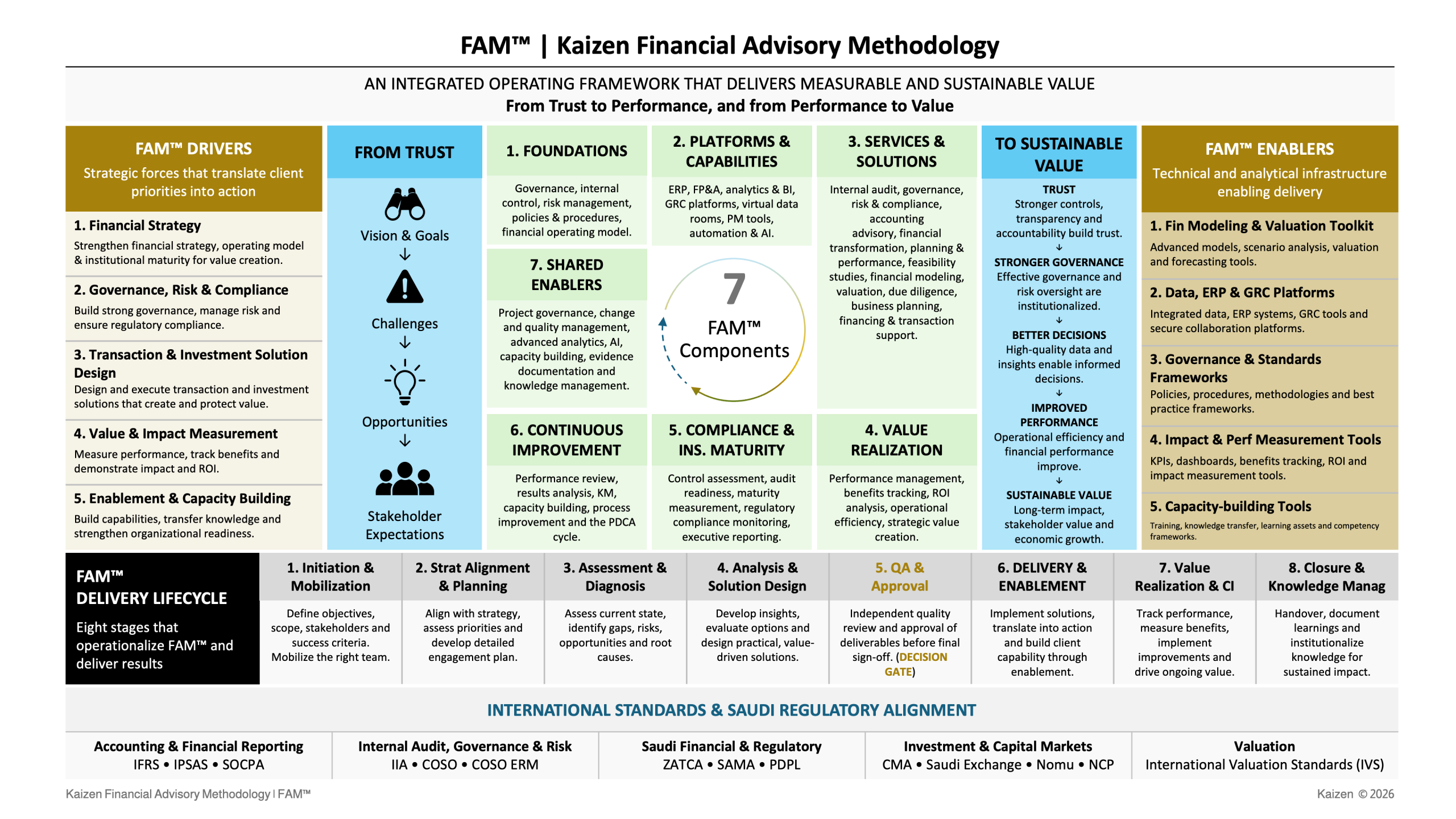
FAM™ combines five strategic drivers, seven interconnected components, and five enablers within eight delivery stages, guiding engagements from mobilization and diagnosis through solution design, independent assurance, implementation, and measurable results.
Why it Delivers Value?
FAM™ integrates evidence-based analysis, independent quality assurance, regulatory alignment, and capacity building to reduce risks, enhance accountability, strengthen financial performance, and deliver measurable, sustainable institutional and investment value for clients.
Constituent Elements of FAM™

FAM™ Drivers
FAM™ Drivers turn organizational financial ambitions into clear strategic direction, ensuring every advisory engagement addresses priority challenges, supports informed choices, and advances meaningful, lasting outcomes for clients and stakeholders alike.
Five drivers define the agenda: Financial Strategy & Institutional Maturity assesses financial capabilities; Governance, Risk & Compliance strengthens oversight; Transaction & Investment Solution Design shapes valuation and deal solutions; Value & Impact Measurement establishes indicators; and Enablement & Capacity Building embeds training, knowledge transfer, and organizational readiness through practical coaching.
FAM™ 7 Components
FAM™ Components connect the essential building blocks of financial advisory into one coherent operating architecture, enabling integrated execution, disciplined governance, and a continuous pathway from institutional foundations to lasting results.
Seven elements form the architecture: Foundations establish controls and policies; Platforms & Capabilities supply digital infrastructure; Services & Solutions cover advisory disciplines; Value Realization tracks benefits; Compliance & Institutional Maturity monitors adherence; Continuous Improvement applies performance reviews and PDCA; and Shared Enablers support projects through change management and knowledge management.

FAM™ Capabilities
FAM™ Capabilities equip advisory teams with practical resources to execute complex financial assignments efficiently, maintain analytical rigor, and translate specialized expertise into reliable, repeatable solutions across diverse financial advisory contexts.
Five enablers provide the toolkit: Financial Modeling & Valuation Toolkit includes integrated forecasts, DCF, comparables, and sensitivity analysis; Data, ERP & GRC Platforms support operations; Governance & Standards Frameworks reference IFRS, IPSAS, COSO, and IIA; Impact & Performance Measurement Tools supply dashboards; Capacity-Building Tools provide structured training and knowledge transfer.




FAM™ Delivery Lifecycle
The FAM™ Delivery Lifecycle provides a controlled journey for each engagement, establishing clear accountability, timely decisions, and formal approval checkpoints while protecting quality and sustaining measurable value beyond project completion.
Eight stages structure work: Initiation & Mobilization establishes readiness; Strategic Alignment & Planning confirms scope; Assessment & Diagnosis identifies gaps; Analysis & Solution Design develops options; Quality Assurance & Approval validates outputs; Delivery & Enablement supports adoption; Value Realization & Continuous Improvement measures benefits; Closure & Knowledge Management preserves learning.
How FAM™ Delivers Value?
FAM™ Success Model in Eight Stages
FAM™ transforms financial priorities into measurable and sustainable value through an integrated eight-stage delivery lifecycle. From engagement mobilization and strategic alignment to financial diagnosis, solution design, independent quality assurance, and implementation support, each stage produces defined deliverables and measurable outcomes. Supported by financial analytics, governance frameworks, KPIs, and executive dashboards, FAM™ strengthens institutional performance, ensures accountability, and drives continuous improvement.
Stage 1 — Initiation & Mobilization
Goal: Establish engagement readiness, governance, accountability, and a coordinated foundation for successful execution.
Scope: Mobilize teams, define roles and responsibilities (RACI), conduct kickoff meetings, confirm information requirements, establish reporting protocols, and complete confidentiality, independence, and conflict-of-interest checks.
Exit Gate: Engagement charter approved, governance requirements completed, responsibilities agreed, and baseline information availability confirmed.
Stage 2 — Strategic Alignment & Planning
Goal: Align financial advisory objectives with institutional strategy, stakeholder expectations, and engagement priorities.
Scope: Assess client needs, define scope and exclusions, map stakeholders, develop execution plans and timelines, establish governance and communication arrangements, and identify initial risks.
Exit Gate: Project charter, scope, execution plan, and governance structure approved, with execution prerequisites confirmed.
Stage 3 — Assessment & Diagnosis
Goal: Establish a reliable understanding of financial performance, institutional maturity, risks, and improvement opportunities.
Scope: Collect and validate data, assess financial processes and internal controls, evaluate risks and compliance, conduct benchmarking and root-cause analysis, and prioritize performance gaps.
Exit Gate: Diagnostic findings approved, data reliability verified, and priority gaps, risks, and improvement opportunities validated.
Stage 4 — Analysis & Solution Design
Goal: Develop practical, evidence-based financial solutions that address identified gaps and deliver measurable institutional value.
Scope: Design advisory solutions, evaluate alternatives, conduct financial and scenario analyses, develop implementation roadmaps and target operating models, and establish KPIs, targets, and accountability.
Exit Gate: Proposed solutions, implementation roadmap, target operating model, and performance indicators approved.
Stage 5 — Quality Assurance & Approval
Goal: Ensure the accuracy, reliability, professional integrity, and regulatory compliance of financial advisory deliverables.
Scope: Conduct independent quality reviews, verify financial assumptions and analytical models, assess compliance with applicable standards, review stakeholder feedback, and resolve material findings.
Exit Gate: Independent quality review completed, material comments resolved, and final deliverables formally approved for release.
Stage 6 — Delivery & Enablement
Goal: Translate approved financial solutions into practical application while strengthening organizational capabilities and implementation readiness.
Scope: Deliver final outputs, present recommendations, conduct training and knowledge transfer, assess organizational readiness, support implementation and change management, and establish performance measurement baselines.
Exit Gate: Final handover approved, knowledge transfer completed, and implementation and monitoring plans formally endorsed.
Stage 7 — Value Realization & Continuous Improvement
Goal: Measure achieved financial and institutional benefits, improve performance, and sustain long-term value creation.
Scope: Monitor implementation, track financial and operational KPIs, assess outcomes against established baselines, evaluate return on investment, conduct post-implementation reviews, and develop continuous improvement initiatives.
Exit Gate: Impact measurement results approved, targeted benefits confirmed, and continuous improvement plan endorsed.
Stage 8 — Closure & Knowledge Management
Goal: Complete engagement obligations, institutionalize acquired knowledge, and strengthen the sustainability of future performance improvements.
Scope: Finalize contractual deliverables, assess client satisfaction, document lessons learned, consolidate knowledge assets, archive working files, and complete agreed information retention or disposal procedures.
Exit Gate: Engagement formally closed, knowledge documentation completed, and all contractual obligations fulfilled.
Have Any Queries?
Get a Free Consultation
One of our consultants will contact you soon.