














ReportOverview Report
Why Data Management Offices (DMOs) Fail to Realise Their Strategic Value
How to bridge the gap between technology and operations

Digital, AI & Data
Experience & Excellence
Development & Capacity
WHO WE SERVE
Projects, Clients & Consultants
How to bridge the gap between technology and operations
In the modern digital economy, data should be treated as a tangible organisational asset rather than a purely technical by-product. It is no longer a secondary output of IT systems; it is a strategic resource that requires governance and management extending beyond software code and infrastructure (DAMA International, 2017).
Despite this shift, many organisations struggle to realise value from establishing Data Management Offices (DMOs). A persistent challenge is functional disconnection: the DMO operates as a conceptual or policy unit, IT as an execution unit, and business units as data consumers. This fragmentation dissipates the expected value of data and weakens enterprise-wide governance.
Drawing on professional experience in establishing and operating DMOs at Kaizen Consulting, the author observes a “silent gap” threatening even the largest data governance initiatives. In many entities, the DMO becomes an isolated island that produces paper-based policies, while technical and operational realities follow a completely different trajectory.
This structural challenge is widely recognised in academic and professional literature as data silos, the separation of governance from execution and the lack of institutional integration between DMOs, IT, and operational units (Khatri and Brown, 2010). The result is a governance model that exists in theory but not in practice.
1. DMO–IT structural conflict
IT departments often perceive the DMO as an administrative burden or a compliance body that slows delivery. This perception leads to:
Such misalignment undermines the integration of governance into the system development lifecycle and reinforces siloed practices (Otto, 2011).
2. Knowledge gap between DMO and business units
Operational departments typically treat data from a short-term, immediate-need perspective, while DMOs approach data from a sustainability and governance perspective. This gap results in:
The literature highlights this issue as a failure to embed governance roles within business processes, rather than positioning them as external controls (Weber, Otto and Österle, 2009).
From an academic standpoint, three root causes explain this persistent disconnection:
To address this fragmentation, organisations must shift from a model of isolated islands to a strategic partnership model. This transition involves coordinated action across governance, operations, technology, and organisational structure.
Governance: from control to enablement
Data governance should evolve from a compliance-focused model to an enabling one. The DMO should move from saying “no” due to non-compliance to providing practical tools, such as data dictionaries and automated data quality mechanisms, that facilitate technical and operational performance (Weber, Otto and Österle, 2009).
Operations: activating data owners and stewards
Each business unit should formally appoint Data Owners and Data Stewards to act as active interfaces with the DMO. Their responsibilities go beyond nominal titles:
This approach embeds accountability directly within business operations (Khatri and Brown, 2010).
Technology: procedural integration with the SDLC
Data standards review must become a mandatory step within the Systems Development Life Cycle (SDLC). No system should be launched without formal DMO approval of its data architecture from the earliest design phase. This ensures that governance is “coded into” systems rather than retrofitted later (Otto, 2011).
Organisation: establishing a steering committee
A cross-functional steering committee, led by senior management and comprising IT, operations, and the DMO, is essential. Its role is not to debate technical details, but to ensure that:
Such governance bodies are widely recognised as critical for aligning strategy, governance, and execution (DAMA International, 2017).
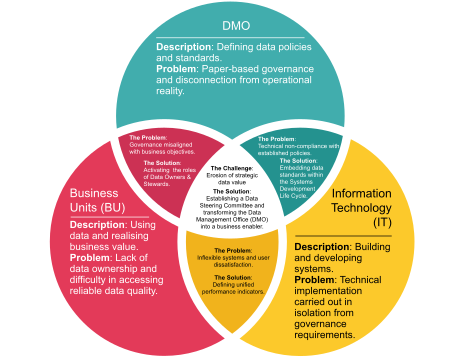
Data can only generate maximum value when treated as the nervous system of the organization, connecting the brain (leadership) to the limbs (operations) through technological pathways. The success of a DMO should not be measured by the number of policies produced, but by the extent to which those policies are embedded in IT code and reflected in everyday operational decisions.
The central question remains: in your organisation, is the Data Management Office an enabler of business value, or merely a regulatory body?
This report highlights that the failure of many DMOs is not technical but structural and cultural. Bridging the gap between governance, technology, and operations requires redesigning operating models, aligning incentives, embedding stewardship roles, and integrating governance into system development. When these elements converge, data governance shifts from theory to practice, enabling sustainable, data-driven value creation across the enterprise.

Overview Report


Overview Report